THE CYCLE OF CODEPENDENCY: WHEN YOUR SELF-WORTH DEPENDS ON BEING NEEDED
Codependency is one of those words that gets used so often that it can start to mean everything and nothing. Sometimes it's used to describe anyone who stays in a difficult relationship, cares deeply about another person, or struggles with boundaries. I don't find that especially helpful.
I tend to think less about whether someone is codependent and more about whether there are codependent patterns happening in their relationships. Those patterns might include feeling responsible for other people's emotions, over-functioning for people we love, struggling to identify our own needs, trying to fix or rescue others, having difficulty saying no, or getting a significant part of our sense of worth from being useful or needed.
When we look at codependency this way, the question becomes less “What's wrong with me?” and more “What have I learned I need to do in order to feel valuable, safe, or connected?”
And for many people, that question leads us directly to self-worth.
WHEN BEING NEEDED BECOMES HOW WE KNOW WE MATTER
There is nothing inherently unhealthy about wanting to be needed. Humans are relational. It feels good to know that we matter to people, that someone trusts us, or that our presence makes another person's life better.
The difficulty comes when being needed becomes one of the only reliable ways we know we're valuable.
Maybe you feel most confident when someone comes to you for advice. Maybe you become the person everyone calls during a crisis. Maybe you're incredibly good at anticipating what people need before they ask. Maybe relationships feel most secure when you're helping, fixing, supporting, organizing, reassuring, or taking care of someone.
Being needed can provide a powerful sense of purpose. It can tell us, I matter here. I have something to offer. There is a reason this person will keep me around.
That can make stepping out of the caretaker role feel much scarier than simply learning to say no.
HOW THE CYCLE CAN START
Codependent patterns don't come from one universal cause. Family dynamics, attachment experiences, culture, relationships, trauma, gender expectations, religious teachings, and many other experiences can influence how we learn to relate to ourselves and other people.
Maybe you grew up in a family where being helpful received praise. Maybe a parent struggled emotionally and you became highly attuned to their mood. Maybe you were expected to be mature, responsible, or independent earlier than was appropriate. Maybe conflict felt unpredictable, so you became good at keeping everyone happy. Maybe you learned that having needs created stress for other people, while meeting other people's needs brought connection.
Eventually, a relational rule can start forming: I am safest when I'm useful.
You may not consciously believe that. But you might notice how uncomfortable you feel when you aren't needed, how quickly you step in when someone struggles, or how difficult it is to imagine letting another person solve their own problem.
What began as adaptation can become the way we organize our relationships.
THE CODEPENDENCY CYCLE
A common cycle can look something like this: someone you care about has a need, problem, uncomfortable emotion, or crisis. You notice it quickly and feel an urge to help. Helping gives you relief, connection, purpose, or reassurance that you're valuable in the relationship, so you take on more responsibility.
Over time, however, you may begin doing more than you actually have the capacity or desire to do. Your own needs move further down the list. You become tired, frustrated, anxious, or resentful, but saying no feels difficult because you don't want to disappoint the other person or stop being someone they can rely on.
Eventually, you may reach a point where you feel unappreciated. Why doesn't anyone take care of me like this? Why am I always the one who has to handle everything? Why doesn't anyone notice how much I'm doing?
Then guilt enters. You feel bad for being resentful because they need you. You tell yourself you should be more understanding. You recommit to helping, fixing, or caretaking, and the cycle starts again.
This isn't because you're manipulative or secretly trying to control everyone. Often, both care and fear are operating at the same time. You genuinely love people and may have learned that caring for them is one of the ways you maintain security in your relationships.
OVER-FUNCTIONING CAN MAKE UNDER-FUNCTIONING EASIER
One uncomfortable part of examining codependent patterns is noticing that helping isn't always neutral.
Sometimes the more we take responsibility for another capable adult, the less responsibility they have to take for themselves. If we constantly remind, organize, rescue, fix, anticipate, or intervene, we may unintentionally help maintain a dynamic where one person increasingly over-functions while the other increasingly relies on that over-functioning.
This doesn't mean every struggling person simply needs to “take responsibility,” and it certainly doesn't mean we should never help people. Relationships naturally involve periods where one person carries more. Disability, illness, grief, financial hardship, parenting, caregiving, and countless other circumstances can require significant support.
The question is whether the dynamic has become rigid. Am I helping because I've consciously chosen to, or because I don't believe the other person—or I—can tolerate what happens if I don't?
Sometimes loving someone means helping them. Sometimes loving someone means allowing them to experience the natural discomfort of managing something themselves.
RESENTMENT IS SOMETIMES A CLUE
Resentment gets a bad reputation, especially among people who pride themselves on being caring. But I think resentment can contain useful information.
If you continually say yes when you want to say no, resentment may eventually tell you that something isn't working. If you're always available but never ask for support yourself, resentment may reveal how one-directional the relationship has become. If you repeatedly rescue someone and then become angry that they aren't changing, resentment may be showing you that you've taken responsibility for an outcome you can't actually control.
The answer isn't always “The other person needs to do more.” Sometimes the question is “What am I doing that I no longer want to be doing?”
That's a very different question because it brings our attention back to the part of the relationship we actually have control over: ourselves.
WHY SETTING BOUNDARIES CAN FEEL LIKE LOSING YOUR WORTH
If your self-worth has become intertwined with being helpful, setting a boundary doesn't simply mean declining a request. It can threaten an identity.
If I'm not the person who always helps, who am I? If they don't need me, will they still want me? If I stop fixing everything, what value do I bring to the relationship? If someone is disappointed in me, does that mean I'm selfish?
This is why advice like “Just say no” can feel wildly insufficient. Sometimes the difficult part isn't figuring out the word no. It's tolerating everything the word brings up afterward.
Guilt. Anxiety. Someone else's disappointment. The urge to explain yourself. The fear that the relationship will change. The discomfort of watching someone struggle with something you know you could fix.
Boundaries give us an opportunity to discover something important: maybe people can love us even when we aren't useful to them.
BUILDING SELF-WORTH OUTSIDE OF WHAT YOU DO FOR OTHER PEOPLE
Breaking codependent patterns isn't just about doing less for everyone else. If we remove caretaking without building another relationship with ourselves, we may be left with an enormous empty space.
Part of the work is discovering what makes you valuable when nobody needs anything from you.
What do you enjoy? What matters to you? What are your values? What relationships feel mutual rather than dependent on what you provide? What do you want your life to contain outside of being helpful? Who are you when you're resting, playing, creating, learning, receiving, or simply existing?
These questions can feel strangely difficult if your identity has been built around roles like caretaker, helper, fixer, peacemaker, responsible one, or strong one.
You don't need to stop being any of those things. You just deserve an identity that's bigger than what you can provide.
LEARNING TO LET OTHER PEOPLE TAKE CARE OF THEMSELVES
Another part of changing codependent patterns is learning to trust other capable adults with their own lives.
Someone can be disappointed without you fixing it. Someone can make a decision you disagree with. Someone can have a problem and ask for your support without that problem becoming yours. Someone can say no to you, and you can say no to them.
This doesn't mean relationships become hyper-independent. Healthy relationships involve interdependence: we rely on each other, support each other, influence each other, and sometimes carry each other through difficult seasons.
But interdependence leaves room for two people.
Your needs matter alongside theirs. Their emotions can affect you without becoming your responsibility. You can offer help without taking ownership. You can be generous without abandoning yourself.
PRACTICING SOMETHING DIFFERENT
Breaking the cycle usually happens in small moments rather than one enormous transformation. Maybe you wait before volunteering to solve a problem. You ask someone whether they want support instead of automatically giving advice. You let a capable adult experience the consequence of a choice they made. You notice resentment and ask what boundary it might be pointing toward. You receive help without immediately finding a way to repay it.
Maybe you say no and don't write a paragraph explaining why. You tell someone what you need before you're completely overwhelmed. You let someone be disappointed in you. You notice the urge to rescue and wait long enough to ask yourself, “Is this actually mine to fix?”
Those moments can feel uncomfortable because you're interrupting a pattern that may have helped you feel valuable and connected for a very long time.
But slowly, you get new information: I can say no and still be loved. I can let someone solve their own problem and still be caring. I can have needs without becoming a burden. I can receive without immediately giving something back. I can matter even when I'm not doing anything for anyone.
YOU DON’T HAVE TO STOP CARING TO STOP ABANDONING YOURSELF
I don't think healing codependent patterns means becoming radically independent, caring less, or refusing to help anyone. In fact, I think the goal is to make caring more sustainable and more freely chosen.
You get to be generous because generosity matters to you, not because you need it to secure your place in someone's life. You get to help because you want to, not because someone else's struggle automatically becomes your responsibility. You get to love people deeply without managing their lives.
And perhaps most importantly, you get to discover that your value in a relationship doesn't have to come from how much of yourself you're willing to give away.
If this resonates with you—especially if being needed, helpful, responsible, or easy to rely on has become deeply connected to your sense of worth—this is something we can explore together in therapy. Learn more about how I work with people-pleasing →
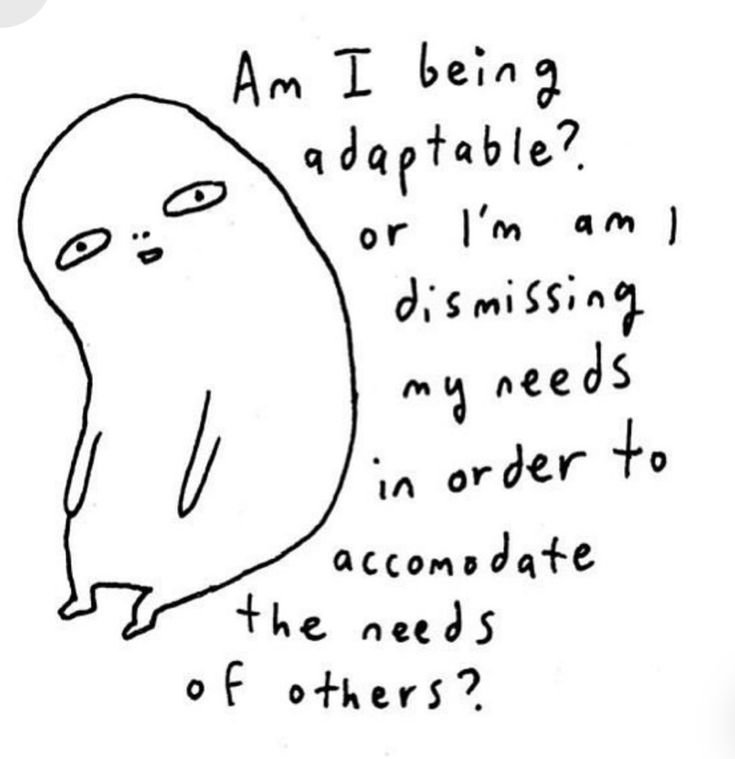
credit: www.instagram.com/anicastillo
