THE CONNECTION BETWEEN TRAUMA & ANXIETY: WHY YOUR ANXIETY MIGHT MAKE MORE SENSE THAN YOU THINK
Sometimes anxiety seems to come out of nowhere. Your brain runs through every possible thing that could go wrong. You replay conversations looking for something you missed. Someone's tone changes and you immediately wonder if they're upset with you. You have a hard time relaxing because there is always something you could be preparing for, fixing, preventing, or figuring out.
And sometimes we respond to all of that by asking, “Why am I like this?”
One of the things I find most helpful about understanding anxiety through the lens of our past experiences is that we can start asking a different question: Why might this make sense?
Not every person with anxiety has experienced trauma, and not every experience of anxiety is a trauma response. Anxiety can be influenced by genetics, temperament, current stressors, physical health, our environments, and plenty of other factors. But for some of us, anxiety makes a lot more sense when we understand what we've learned about safety, relationships, uncertainty, and ourselves.
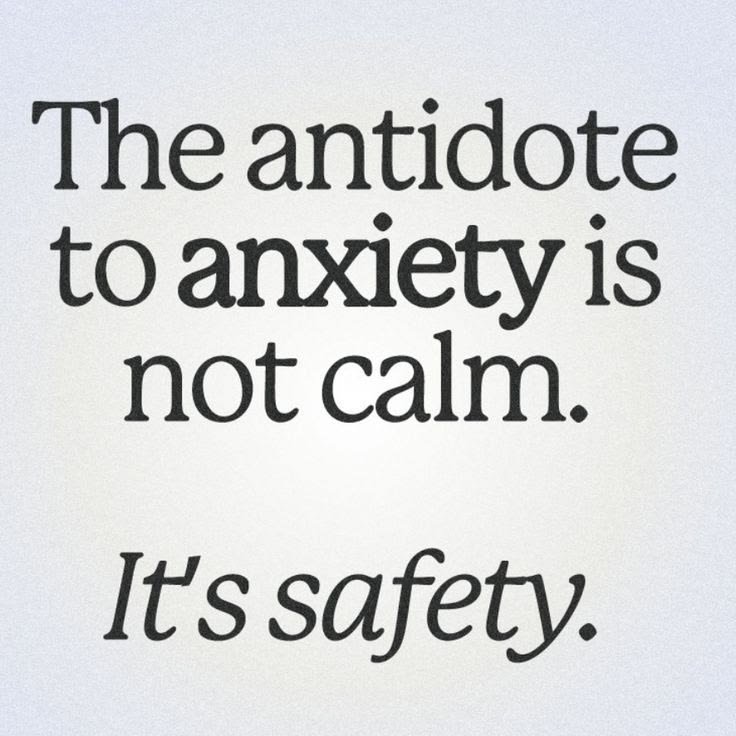
Maybe your anxiety isn't completely random. Maybe your brain has gotten really, really good at trying to protect you.
WHAT DO TRAUMA & ANXIETY HAVE TO DO WITH EACH OTHER?
When I use the word trauma, I'm not only interested in whether something “bad enough” happened to qualify for a particular label. I'm interested in how your experiences shaped you. What did you learn about safety? What did you learn about relationships? What did you have to become really good at? What did you learn to expect from other people? What did your brain learn was necessary to prevent something painful from happening again?
Traumatic and chronically stressful experiences can affect the way we respond to perceived threats later. Our brains learn from experience. If unpredictability, conflict, rejection, criticism, abandonment, or other forms of danger have mattered significantly in the past, it makes sense that we may become especially attentive to signs that they could happen again.
That can look a lot like anxiety.
You might scan people's expressions for signs that something is wrong. You might rehearse conversations beforehand so you're prepared for every possible reaction. You might struggle with uncertainty because knowing what's going to happen feels safer than being surprised. You might avoid situations where you could fail, be rejected, feel trapped, or lose control. You might become incredibly good at anticipating other people's needs because there was once a reason it felt important to know what everyone around you was feeling.
These responses can be exhausting in your life now, but that doesn't mean they developed for no reason.
TRAUMA DOESN’T ALWAYS LOOK LIKE ONE TERRIBLE EVENT
When people hear the word trauma, they often think of experiences like assault, abuse, accidents, natural disasters, or violence. Those absolutely can be traumatic. But the experiences that shape our sense of safety can also be relational and cumulative.
Maybe you grew up around unpredictable emotions and became very good at reading the room. Maybe love felt inconsistent, so you learned to pay close attention to signs that someone might pull away. Maybe mistakes brought criticism or shame, so getting things right became incredibly important. Maybe you were expected to be mature, helpful, successful, or easy. Maybe your emotions weren't welcomed, or you learned that having needs created problems for other people.
None of this means every difficult childhood experience should automatically be labeled trauma. It means our nervous systems and beliefs about ourselves don't develop in a vacuum. We learn what to expect through what we repeatedly experience.
Sometimes what we call anxiety in adulthood is connected to strategies that helped us navigate those earlier environments.
WHY YOU MIGHT FEEL UNSAFE EVEN WHEN YOU KNOW YOU’RE SAFE
This can be one of the most frustrating parts of anxiety: “I know I'm okay, so why don't I feel okay?”
Intellectually knowing that something is safe isn't always the same as experiencing it as safe. Our brains are constantly using past experiences to make predictions about what might happen next. That's incredibly useful when the prediction helps us respond to genuine danger, but it can become exhausting when our threat-detection systems become sensitive to situations that resemble something painful from the past.
Your partner taking longer than usual to text back isn't the same thing as abandonment, but uncertainty might activate an old fear of being left. Receiving constructive feedback from your boss isn't the same as being unsafe, but criticism might carry much more weight if mistakes historically came with shame. Someone being disappointed in you isn't inherently dangerous, but it can feel dangerous if maintaining approval has been closely tied to connection.
This is why telling ourselves “There's nothing to be anxious about” often doesn't magically make anxiety disappear. The anxious response may not be based solely on what's happening right now. Your brain may also be responding to what this moment has come to mean based on what you've experienced before.
HOW FAMILY-OF-ORIGIN EXPERIENCES CAN SHOW UP AS ANXIETY
Our earliest relationships give us some of our first information about ourselves and other people. We begin learning whether other people are generally responsive, whether our emotions are acceptable, whether our needs matter, whether conflict can be repaired, and whether relationships still feel secure when someone is upset.
If those experiences were inconsistent, painful, or unpredictable, we may carry some of those expectations into later relationships without consciously realizing it.
Maybe you feel responsible for everyone's emotions because you grew up monitoring a parent's mood. Maybe you struggle to ask for help because being independent was safer or more praised. Maybe conflict immediately makes you fear losing the relationship because repair wasn't something you experienced consistently. Maybe you have difficulty believing someone is genuinely happy with you unless they're actively reassuring you.
We don't need to blame our families for everything we experience as adults to acknowledge that our families helped shape the way we learned to relate to ourselves and other people. Understanding where a pattern came from can help us stop treating it like evidence that something is fundamentally wrong with us.
TRAUMA, PEOPLE-PLEASING & ANXIETY
This is one of the places where trauma, anxiety, and people-pleasing can become incredibly intertwined.
People-pleasing can look like kindness from the outside, and sometimes it genuinely is kindness. But it can also be driven by anxiety: If you're okay with me, then I'm okay. If nobody is disappointed, then nothing bad is happening. If I can figure out exactly what you need and provide it, maybe I can prevent conflict or rejection.
That can turn relationships into a constant monitoring project. You're watching facial expressions, rereading messages, analyzing changes in tone, wondering whether you said too much, and adjusting yourself according to what you think another person needs.
The difficult part is that these strategies can work—at least temporarily. Avoiding conflict can reduce anxiety in the moment. Reassurance can make us feel better. Saying yes can prevent someone's disappointment. Overpreparing can reduce uncertainty. Our brains notice that relief and learn, Great. Let's do that again next time.
But eventually, the strategies we use to manage anxiety can become part of what keeps it going.
WHEN ANXIETY BECOMES AN ATTEMPT TO CONTROL UNCERTAINTY
I think one of the most uncomfortable truths about being human is that we can't know exactly what is going to happen.
We can't guarantee that someone won't leave us. We can't guarantee that nobody will ever misunderstand us. We can't know whether every decision we're making is the “right” one. We can't prepare for every possible problem, prevent every painful experience, or make everyone respond to us the way we'd like.
For someone whose past experiences have made unpredictability feel dangerous, that can be incredibly difficult to tolerate.
Anxiety often offers us a bargain: If you think about this long enough, maybe you'll finally feel certain. So we analyze the conversation again. We Google one more thing. We ask someone for reassurance. We create another contingency plan. We imagine every possible outcome so nothing can catch us off guard.
The problem is that certainty is usually temporary. Eventually there's another unknown, another decision, another relationship, another possibility to consider.
Part of healing anxiety isn't learning how to control everything well enough that uncertainty disappears. It's slowly developing more trust in our ability to handle what happens even when we don't know exactly what comes next.
HOW TRAUMA CAN AFFECT SELF-WORTH
Trauma and difficult relational experiences don't only influence what we believe about the world. They can influence what we believe about ourselves.
Maybe you learned, I'm too sensitive. I'm difficult. My needs are inconvenient. I'm only valuable when I'm useful. I have to earn love. If someone is upset with me, I've done something wrong. If I'm rejected, it means there is something wrong with me.
Those beliefs can become fertile ground for anxiety because suddenly every interaction contains information about your worth. Someone doesn't respond enthusiastically and you wonder what you did. You make a mistake and it feels like evidence that you're incompetent. Someone sets a boundary and you interpret it as rejection. You need reassurance because you're not simply asking, “Did that interaction go okay?” You're asking, “Am I okay?”
Healing can involve separating those two questions. Something can go badly without you being bad. Someone can be disappointed without you being unworthy. A relationship can end without proving you are unlovable. You can make a mistake without the mistake becoming your identity.
RELATIONSHIP ANXIETY & THE FEAR OF LOSING CONNECTION
For some people, anxiety becomes loudest in relationships. You may feel relatively secure until someone becomes distant, responds differently, seems irritated, or needs space. Suddenly your brain wants answers immediately.
Are we okay? Did I do something? Are you mad at me? Do you still love me?
Attachment patterns can be one useful framework for understanding some of these reactions, although I don't love using attachment styles as rigid personality categories. Our attachment-related responses can vary across relationships and can change over time.
What's often more useful is becoming curious about what happens inside you when connection feels uncertain. Do you pursue reassurance? Shut down? Assume the worst? Become angry? Make yourself easier to love? Pretend you don't care? Try to fix the relationship before you're even sure anything is wrong?
These responses can tell us something about what we've learned to expect from connection.
SO HOW DO YOU ACTUALLY HEAL TRAUMA-RELATED ANXIETY?
If anxiety developed partly through experience, healing often requires more than simply knowing that your anxious thoughts aren't logical. You might already be extremely self-aware. You may know exactly where your patterns came from and still feel your stomach drop when someone's tone changes.
Insight matters, but insight and change aren't always the same thing.
Healing can involve learning skills for tolerating anxiety without immediately obeying it. It can mean noticing when you're seeking certainty or reassurance and experimenting with allowing some uncertainty to remain. It can mean learning to identify and feel emotions instead of immediately fixing them. It can mean practicing boundaries, expressing needs, tolerating disappointment, and discovering that relationships can survive moments that once felt dangerous.
And for trauma specifically, therapy can also give us opportunities to process experiences that continue to carry emotional intensity. Approaches such as EMDR and other trauma-focused therapies can help people work with traumatic memories and the beliefs, emotions, and responses connected to them. CBT and other evidence-based approaches can also be useful for many anxiety disorders, depending on the particular symptoms and diagnosis.
But regardless of modality, I think one of the most important parts of therapy is getting to experience a relationship where you don't have to perform your way into safety. You get to practice being honest, having needs, feeling complicated things, disagreeing, taking up space, and still experiencing connection.
THE GOAL ISN’T TO NEVER FEEL ANXIOUS AGAIN
Anxiety is part of being human. We aren't trying to create a life where you never feel uncertain, uncomfortable, scared, rejected, or out of control. I don't think that's possible, and trying to accomplish it can become its own anxiety project.
Instead, I think we're working toward something more flexible: I can feel anxious without assuming anxiety means danger. I can experience uncertainty without immediately trying to eliminate it. I can notice an old pattern without automatically following it. I can disappoint someone and remain connected to myself. I can feel unsafe for a moment and become curious about whether I actually am.
Maybe your anxiety has spent years trying to make sure you're prepared for everything. We don't have to hate that part of you for doing its job so enthusiastically. But we can help it learn that it doesn't have to work quite so hard anymore.
If this resonates with you—especially if you understand your anxiety intellectually but still find yourself stuck in old patterns of fear, hypervigilance, people-pleasing, or trying to control uncertainty—this is something we can explore together in therapy. Learn more about how I work with anxiety →
credit: source unknown
