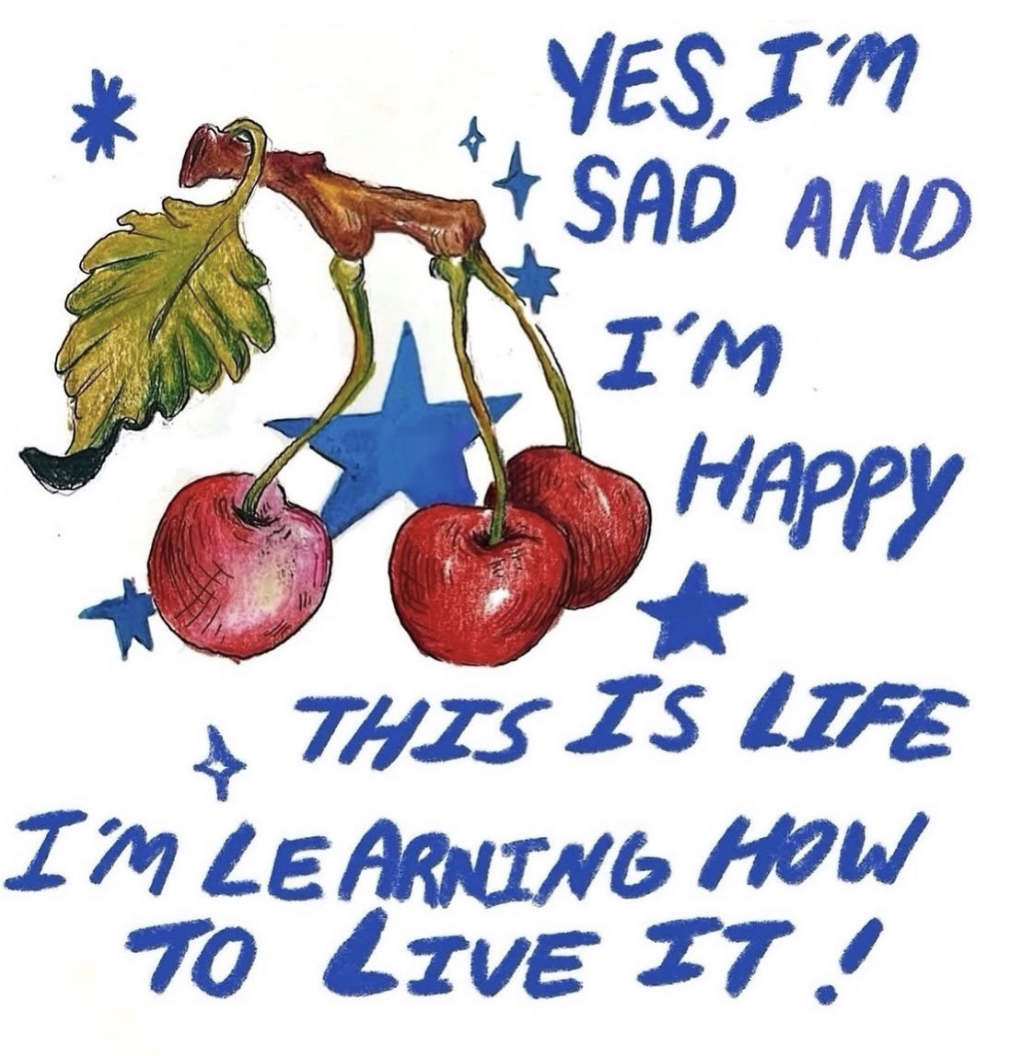
Have you ever had one terrible thing happen and decided the entire day was ruined? Or had someone you love hurt you and suddenly found yourself questioning the whole relationship? Maybe you made one mistake and went from "I messed this up" to "maybe I'm just not good at this" in about four seconds. Our brains really like categories: good or bad, right or wrong, safe or unsafe, successful or unsuccessful. I love this person OR I'm angry with them. I'm a good person OR I did something selfish.
There's something comforting about this kind of black-and-white thinking, because certainty usually feels safer than ambiguity. It's much easier to put an experience, another person, or even ourselves into a neat little box than it is to hold two seemingly contradictory truths at the same time. But humans are complicated!! Relationships are complicated, healing is complicated, and sometimes one tiny word can help us make room for more of that complexity: and.
WHY “BUT” CAN CHANGE THE STORY
Think about the difference between "I had a really difficult morning, but I had a delicious lunch and enjoyed work" and "I had a really difficult morning, and I had a delicious lunch and enjoyed work." Or between "My friend sometimes doesn't consider my feelings, but she does so much for me" and "My friend does so much for me, and sometimes I don't feel considered by her." Same facts, very different feeling!
There's nothing wrong with the word but (I just used it, twice). Sometimes, though, we use it to cancel out the first half of our experience. If I say, "My friend hurt me, but she's a really good friend," I might be quietly telling myself that because she's a good friend, I'm not allowed to be hurt. If I say, "I'm struggling, but other people have it worse," the second half of the sentence becomes the reason I can't acknowledge the first.
This is where I love experimenting with and. My friend does so much for me, AND sometimes I don't feel considered by her. I'm struggling in school, and I'm a hard worker. Today was really difficult, and there were parts of it I enjoyed. Nothing has to cancel anything else out!
THE POWER OF “AND” IN RELATIONSHIPS
I think this matters most in relationships, because the people we love rarely fit neatly into categories of "good" and "bad." Someone can love you and hurt you. Your parents can have done the best they knew how to do, and there can still be things you needed from them that you didn't get. You can understand why someone behaved the way they did and still believe what they did wasn't okay.
You can love someone and need a boundary with them, appreciate everything someone has done for you and still feel angry with them, or miss someone while knowing that having them in your life isn't healthy for you right now. Being able to hold both pieces doesn't tell us what decision to make about a relationship. What it does is let us make that decision with more of our actual experience on the table, and that's a big deal!
THE POWER OF “AND” WITH OURSELVES
We can practice the same thing with ourselves. I made a mistake, and I'm still a good person. I'm disappointed in how I handled that, and I can have compassion for why I reacted that way. I'm really good at my job, and sometimes I struggle. I care deeply about other people, and sometimes I need to choose myself. I'm healing, and some of my old patterns still show up.
One of the ideas I appreciate about person-centered therapy is that growth doesn't require rejecting the parts of ourselves we don't like. Becoming more fully ourselves involves being more and more open to our experience, including the complicated, contradictory, uncomfortable parts of being human. That's harder than deciding "I'm good" or "I'm bad," and it also gives us so much more room to actually be a person.
WHY “AND” CAN FEEL SO UNCOMFORTABLE
Holding two truths at once means giving up some certainty. If someone hurt me AND I love them, I might have to figure out what that means. If my parents loved me and some of my needs weren't met, I may have feelings about my childhood that don't fit into a tidy category. If I'm a compassionate person and I sometimes act in ways I'm not proud of, I have to make room for a more complicated version of myself.
Sometimes black-and-white thinking protects us from exactly this kind of ambiguity, since a clear answer can feel much safer than "it's complicated." Tolerating complexity gives us access to more information, though. In session, I'll sometimes notice someone working really hard to figure out which feeling is the "real" one, and I might gently ask what happens if we let both of them stay in the room for a minute.
PRACTICING THE POWER OF “AND”
Start by noticing when you use but, either/or, always/never, or other language that turns a complicated experience into two opposing choices. Then see what happens if you don't immediately decide which side is correct. Try replacing but with and: I'm grateful for my family, and there are things about my childhood that hurt me. I know why they reacted that way, and I'm still angry. Setting this boundary feels terrible, and I think it's the right boundary for me. I want people to like me, and I don't want their approval to decide every choice I make. I'm scared, and I can still do this!
You don't have to banish the word but from your vocabulary forever (please don't, it's a perfectly good word). Just notice the moments when you're using it to explain away something that's also TRUE. Sometimes there isn't one correct side of our experience. Sometimes we're sad and relieved, angry and compassionate, grateful and hurt, healing and struggling. Maybe we don't have to figure out which one we're "really" feeling, and maybe both get to be true :)
If this resonates with you, especially if you find it hard to hold complicated feelings about the people you love or to trust your own experience in relationships, this is something we can explore together in therapy. Learn more about how I work with relationships & relational trauma →
I offer online therapy for women in Alaska, Arizona, Texas, Utah & Washington. Schedule a free 15-minute consultation.