Have you ever noticed that you feel most valuable in your relationships when you're doing something for someone? Maybe you're the one who takes care of everyone, keeps the peace, makes people laugh, or tries very hard not to have too many needs of your own. Somewhere along the way, you may have learned that being loved has less to do with who you ARE and a lot to do with what you provide.
Carl Rogers, the founder of person-centered therapy, used the term conditions of worth to describe the conditions we can internalize around being accepted or valued. I like to think of them almost like formulas we carry into our relationships without realizing it: I need to ______ in order to feel loved. Maybe your blank is be happy, take care of others, make people laugh, keep the peace, be successful, be useful, or not be needy.
The tricky part is that most of us aren't consciously walking around thinking, "I need to keep everyone happy or nobody will love me." These beliefs get so familiar that they just feel like who we are. What we notice instead are the behaviors that grow up around them: saying yes before we've even thought about it, feeling guilty when someone is disappointed, struggling to ask for help, or monitoring everyone's mood in the group chat.
HOW CONDITIONS OF WORTH DEVELOP
Conditions of worth usually don't develop because someone explicitly said, "I will only love you if you're useful." The messages tend to be much subtler than that. Maybe you got more attention when you were successful, or being "easy" made life calmer in your family. Maybe there wasn't much room for your emotions, but you were praised for being independent, or conflict felt scary enough that becoming the peacemaker seemed like the safest role in the house.
Over time, we learn what seems to work in our relationships, and we keep doing it! What started as a really smart way of staying connected can eventually turn into something we feel like we HAVE to do.
This is a big part of why people-pleasing is so hard to change. If people-pleasing were just a bad habit, you could probably decide to stop and be done with it (wouldn't that be nice). But if saying yes or keeping the peace has become tied to your sense of worth or relational safety, doing something different feels much bigger than changing a behavior. It feels like risking connection.
WHEN WHO YOU ARE BECOMES WHAT YOU PROVIDE
There's nothing unhealthy about being helpful, generous, funny, responsible, compassionate or accommodating. Those might be real parts of who you are and values you care about deeply! The question is whether you experience those qualities as CHOICES or as requirements. There's a difference between "I take care of people because caring for others matters to me" and "I need to take care of people so they'll need me." There's also a difference between "I love making people laugh" and "I need everyone to be okay, and humor is how I make sure they are."
When our worth gets tied to what we provide, relationships can start to feel transactional without us ever meaning for them to. We give, fix, perform and stay easy, and somewhere underneath all of it is the hope that doing those things will secure love, approval or safety. Eventually, that gets exhausting!!
WHAT HAPPENS WHEN YOU STOP DOING?
One way to start identifying your own conditions of worth is to notice what happens when you don't meet them. If you're the helpful one, what happens inside you when you say no? If you're the peacemaker, what happens when someone is upset and you don't jump in to fix it? And if you're the independent one, what happens when you need support?
This is often where guilt, anxiety, shame or fear start showing up. You can know you're allowed to have needs and still feel deeply uncomfortable expressing one. You can know you're allowed to set boundaries and still spend three hours rereading the text to figure out whether they're mad at you. Those reactions are clues about the invisible rules you've learned for staying connected.
LEARNING THAT YOU DON'T HAVE TO EARN YOUR PLACE
So how do we start loosening these conditions? Awareness is an important first step. We can get curious about the rules we're carrying instead of judging ourselves for having them. What do I believe I have to provide in order to be valuable? What am I afraid would happen if I stopped? Where might I have learned that? Maybe being easy really did help you keep connection, or taking care of everyone really did give you a role in your family, and recognizing that can make a frustrating pattern make a lot more sense. It doesn't mean you have to keep living by the same rules forever.
From there, we can start experimenting. We can practice saying no and letting someone be disappointed, asking for help without immediately paying it back, and being sad without making our emotions easier for everyone else to handle. We can let someone love us on a day when we haven't been productive or impressive at all. And slowly, we start gathering new experiences of connection: I didn't fix it, and they stayed. I had a need, and they cared. I disappointed someone, and I survived it. I wasn't useful today, and I still mattered.
None of this means you have to stop being generous, helpful, loving or supportive! It's about letting those things become choices instead of the price you believe you have to pay for connection. You're allowed to love people deeply and show up for them! Your worth just isn't determined by how useful you are to everyone around you. You don't have to keep doing something to earn the right to be loved, because you get to be a human BEING, not a human doing :)
If this resonates with you, especially if you feel most lovable when you're useful, needed, easy, or taking care of everyone else, this is something we can explore together in therapy. Learn more about how I work with people-pleasing →
I offer online therapy for women in Alaska, Arizona, Texas, Utah & Washington. Schedule a free 15-minute consultation.
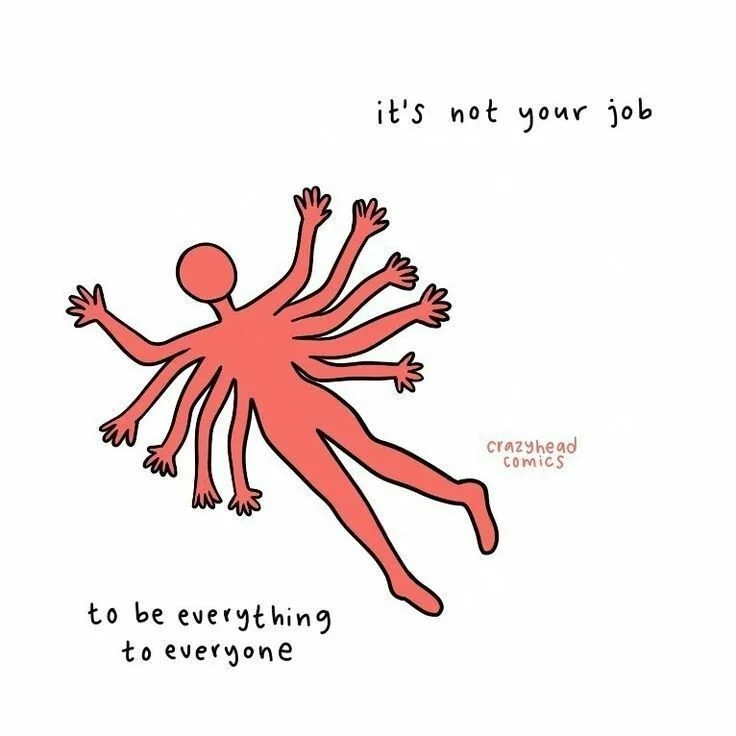
credit: www.instagram.com/crazyheadcomics
