WHY LONG-TERM THERAPY?
When you're looking for a therapist, you might see everything from “6–12 sessions” to weekly therapy for the foreseeable future. I tend to fall more into the latter camp. Most of my clients start by seeing me weekly, and many of the people I work with choose to stay in therapy longer-term. That doesn't mean I believe everyone needs therapy forever, that we aren't working toward anything, or that I want you to become dependent on therapy. It has much more to do with the kind of therapy I do.
I work relationally and often with things that have been developing for a very long time: people-pleasing, anxiety, attachment wounds, relationship patterns, religious trauma, trauma, difficulty trusting yourself, and protective strategies that may have been around since childhood. We're usually not just trying to solve whatever problem happened this week. We're trying to understand—and eventually change—the patterns underneath it, so let's talk about why that can take some time.
WHY DO YOU ASK CLIENTS TO MEET WEEKLY, ESPECIALLY IN THE BEGINNING?
Before we can do deeper work together, we need to build a relationship in which deeper work actually feels possible. Therapy asks you to do some pretty vulnerable things. I'm eventually going to ask you to tell me things you might not tell many other people. I might ask what you noticed when I said something, or we might talk about something that happened between us in therapy. I might gently point out when I notice you disappearing into people-pleasing, intellectualizing, perfectionism, humor, or another protective strategy. We might process trauma together. For any of that to happen, you need some amount of safety with me, and safety in a relationship usually develops through repeated experiences of the relationship being safe.
You tell me something vulnerable, and I respond. You disagree with me, and we're okay. I misunderstand you, and we repair it. You show me something you normally hide, and I don't leave. You learn what I'm like, and I learn what you're like. Over time, hopefully your brain starts collecting evidence: Oh. Maybe I don't have to perform here. Maybe I don't have to take care of her. Maybe I can say what I actually think. Maybe she can handle my emotions. Maybe I can be known here. That takes time, and meeting weekly gives us enough continuity to begin building that kind of relationship.
WHY NOT START WITH THERAPY EVERY OTHER WEEK?
For some kinds of therapy and some clients, every-other-week therapy can work perfectly well. It's just generally not how I prefer to begin the kind of work I do. When there are two or three weeks between appointments, a lot of life happens. Then you come in and understandably need to tell me, “Okay, SO MUCH has happened.” Suddenly we're spending much of our session catching up on the argument with your partner, the terrible meeting at work, what your mom said, and the anxiety spiral you had last Tuesday.
Those things absolutely belong in therapy. I'm interested in what happened last Tuesday! But if we're continually catching up on what happened, it can be harder to slow down enough to ask, Wait. What keeps happening underneath all of these different situations? That's often where the work I'm interested in lives. Weekly therapy gives us more opportunities to move from reporting what happened → noticing the pattern → experiencing what's underneath it → trying something different.
BUT WHAT IF NOTHING HAPPENED THIS WEEK?
Honestly? Amazing!! Therapy doesn't have to be an emergency meeting, and you don't need to bring me a crisis every week to justify having a session. Some of our most interesting sessions might start with, “I genuinely don't know what to talk about today.” That's because relational therapy isn't only about bringing me a sufficiently interesting topic for us to analyze. You are in the room. I am in the room. Whatever starts happening between us when there isn't an obvious agenda can give us information too.
Maybe you immediately feel responsible for entertaining me. Maybe silence feels unbearable. Maybe you worry I'm secretly thinking, Why is she even here? Maybe you start frantically searching your brain for something sufficiently important to make the session “worth it.” Okay, now we have something interesting. What's it like to have another person sitting across from you without knowing exactly what they expect from you? What happens when you aren't being productive? Why does it feel like you need to make therapy worthwhile for me? What happens if neither of us immediately rushes to fill the silence?
Suddenly, “I don't have anything to talk about” has given us quite a bit to talk about. And sometimes nothing particularly profound emerges at all. We spend an hour together. We talk. We notice things. We laugh. We exist in the relationship without needing to produce a breakthrough on demand. That's part of therapy too.
SO…ARE WE JUST GOING TO TALK ABOUT MY CHILDHOOD FOREVER?
No :) But we probably are going to get curious about how your past shows up in your present. You learned how relationships work somewhere. You learned what happens when people are angry, whether having needs was okay, what made you lovable, whether conflict meant danger, what happened when you cried, and whether you needed to be easy, successful, helpful, funny, quiet, independent, perfect, or useful in order to feel secure in your relationships.
Some of those lessons may still be operating automatically. We're not interested in your childhood because the past is inherently more important than your life today, or because every mildly inconvenient thing your parents did needs to become a six-month therapy investigation. We're interested because sometimes your present makes considerably more sense once we understand what you learned from your past. Then we can start figuring out which of those lessons still fit your life and which ones your brain is continuing to follow because nobody ever told it the rules had changed.
CAN’T I UNDERSTAND ALL OF THAT PRETTY QUICKLY?
Sometimes! A lot of my clients are extremely self-aware. You may figure out within a few months, “Ohhhhh. I people-please because I learned that other people's emotions were my responsibility.” That's an important realization. Unfortunately, your brain doesn't immediately respond, “Excellent insight! People-pleasing program successfully uninstalled.” You can understand exactly why you're doing something and still feel an enormous amount of anxiety when you try to behave differently.
That's because insight is only one part of change. Maybe you completely understand that other people's disappointment isn't your responsibility, but the first time you say no and someone is actually disappointed in you, every part of you wants to take the boundary back. Longer-term therapy gives us time not only to understand a pattern, but to notice it happening, experiment with something different, deal with all the feelings that brings up, and keep practicing until the new response becomes increasingly available to you.
WHAT EXACTLY ARE WE DOING FOR ALL THAT TIME?
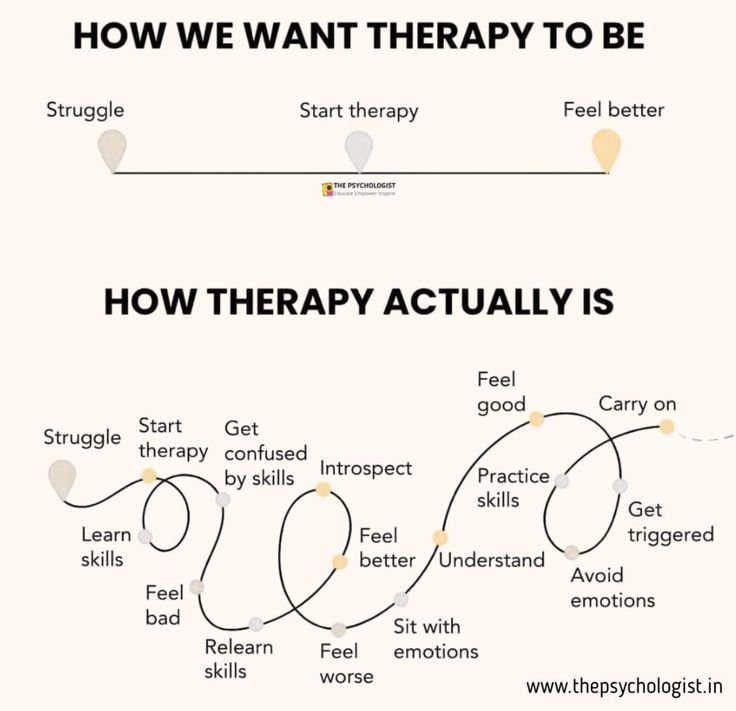
Hopefully, changing—just not necessarily in a straight line. We might spend time understanding your patterns, then noticing them in real time, then discovering what they're protecting. We might learn to recognize emotions you normally avoid, experiment with boundaries, process trauma, or start practicing what it feels like to trust your own interpretation of something. Then we might discover that setting a boundary brought up an enormous amount of guilt, realize that guilt connects to something much older, work with that, and then practice the boundary again.
Healing often looks less like completing a curriculum and more like returning to some of the same themes with increasing capacity, awareness, flexibility, and choice. Then one day you tell me about something that happened, and halfway through the story we both realize, Wait. Six months ago this would have destroyed your entire week. You still got anxious, but you recovered in an hour instead of three days. You noticed the urge to people-please and didn't automatically follow it. You had a conflict and didn't immediately assume the relationship was over. Those shifts can be easy to miss precisely because change doesn't always arrive as one enormous breakthrough.
DOES LONG-TERM THERAPY MEAN BECOMING DEPENDENT ON YOUR THERAPIST?
I don't want to make decisions for you. I don't want you to need my approval before you trust yourself, and I don't want therapy to become the only place where you can regulate, feel, connect, or be understood. Ideally, it's almost the opposite: our relationship becomes one place where you get to practice things that gradually become more available everywhere else.
You practice disagreeing with me. You practice trusting yourself when I see something differently. You practice telling me when I've hurt your feelings or gotten something wrong. You practice having needs, letting another person support you, setting boundaries, being imperfect, and discovering that connection can survive all of those things. Hopefully, over time, those capacities increasingly belong to you, not to therapy. The relationship matters precisely because we're trying to help you carry more of what happens inside of it into the rest of your life.
HOW WILL I KNOW WHETHER THERAPY IS ACTUALLY WORKING?
This is a question I want you to ask because long-term therapy shouldn't mean therapy without direction. We should be able to talk about what you wanted when you came in, what's changing, what's still really hard, whether our work feels useful, and whether there's something we need to do differently.
Progress might look like noticing your patterns sooner or recovering from triggers faster. Maybe you can experience an emotion without immediately needing to make it disappear. Maybe you tolerate someone being disappointed in you, recognize when you're abandoning yourself to preserve a relationship, or set a boundary and survive the guilt afterward. Maybe you need less reassurance or trust your interpretation of your own experiences more. Your protective responses might still show up, but you have more choice about whether you follow them.
Sometimes progress is dramatic, and sometimes it's realizing, Oh. I still got anxious, but this time I didn't spend four hours trying to fix it. I think those smaller moments matter enormously because the goal was never necessarily to become someone who never feels anxious, hurt, scared, or triggered again. Often we're trying to change what happens next.
WILL I NEED WEEKLY THERAPY FOREVER?
Probably not. Weekly therapy is a starting structure, not a lifetime contract. As therapy progresses, there may come a point where it makes sense to talk about reducing frequency, taking a break, or ending therapy, and ideally that's something we discuss together rather than you having to mysteriously disappear from my calendar when you decide you're “done enough.”
Ending therapy also isn't evidence that the relationship wasn't meaningful. In fact, getting to have a thoughtful, intentional ending to a meaningful relationship can be part of the therapeutic work itself. We can talk about what ending brings up, what you've learned, what you're taking with you, what you might miss, and what you want your relationship with therapy to look like moving forward. Sometimes getting to experience a relationship that matters and ends without abandonment, anger, or pretending it didn't matter can be meaningful in its own right.
WHAT IF WEEKLY THERAPY DOESN’T WORK FOR MY SCHEDULE?
Then my practice might not be the right fit for you right now, and I genuinely mean that without judgment. Different seasons of life allow for different things. If weekly therapy would create so much scheduling stress that therapy becomes another obligation you're constantly scrambling to accommodate, another therapist's structure may fit your life better.
That doesn't mean you aren't committed enough to therapy, avoiding the work, or doing therapy incorrectly. It means you need therapy that actually works within your life. My preference for weekly sessions is about how I've chosen to structure my practice and the work I do, not a universal rule about the only legitimate way to participate in therapy.
WHAT IF WEEKLY THERAPY DOESN’T WORK FOR MY BUDGET?
This one is complicated because I understand that paying for weekly therapy at my fee is an immense financial privilege. I wish we lived in a system where therapists could be adequately compensated for the time, training, emotional labor, continuing education, administrative work, and expertise involved in providing good therapy without so much of that cost falling directly onto clients. Unfortunately, that's not the system we're working within, and understanding why therapy is expensive doesn't magically make it affordable.
For the type of work I do, the experience and training I bring to it, and the way I've structured my practice so that I can sustainably provide this work, this is my rate. I also don't want someone stretching themselves financially because they feel like working with me specifically is somehow the “right” way to do therapy. If my fee makes weekly therapy financially unsustainable for you, I would much rather you find a therapist you can afford consistently than spend your therapy sessions stressed about how you're going to pay for therapy.
There are other places to look for more affordable care. Open Path Psychotherapy Collective connects people with participating therapists who offer lower-cost sessions, and depending on where you live, you may also be able to find therapists who accept your insurance, community mental health organizations, university or training clinics, or other lower-cost options. Finding a financially sustainable option isn't settling for therapy you aren't serious about; affordability is part of whether therapy actually fits your life.
SO WHY LONG-TERM THERAPY?
Because sometimes we're not trying to fix one problem. We're trying to change a relationship you've had with yourself for decades. We're trying to understand protective strategies that developed for very good reasons, give you different experiences of conflict, boundaries, emotions, vulnerability, trust, and connection, and process experiences you may still respond to as though they're happening now. We're also building a relationship where you can practice doing things differently while another human being is actually there with you.
That kind of work can take time, but not because you're failing therapy, because I'm withholding some magical intervention until session 87, or because I think you should be in therapy forever. Relationships take time. Trust takes time. New experiences take repetition, and some of the patterns we're working with took years—or decades—to develop. I think it's okay to give ourselves some time to change them.
If this sounds like the kind of therapy you're looking for—especially if you want to understand and change patterns around people-pleasing, anxiety, attachment wounds, relationships, religious trauma, or trauma—you can learn more about working with me →.
credit: www.thepsychologist.in
