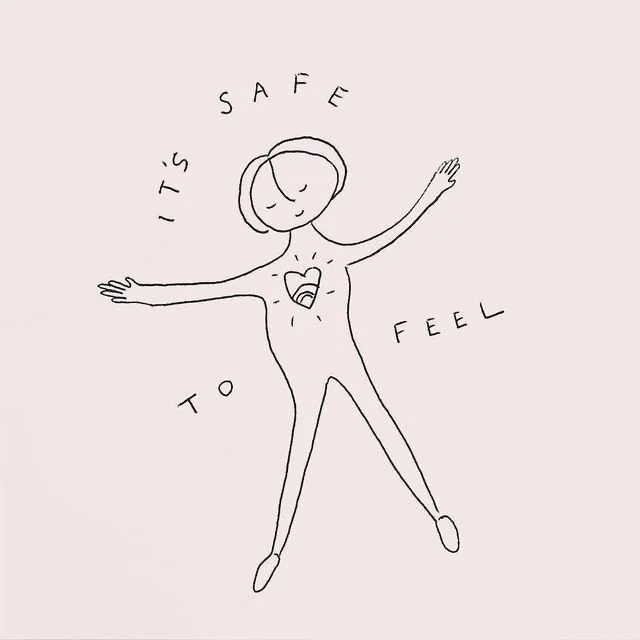
BUT WHY DO I HAVE TO FEEL?
Maybe you've been in therapy for a while. You know why you're anxious. You know you're a people-pleaser because keeping other people happy once helped you feel safe. You know the critical voice in your head probably came from somewhere. You can identify your attachment patterns, explain why conflict sends you spiraling, and probably give a pretty compelling presentation on why disappointing someone feels unbearable. You might even be able to catch yourself in real time and think, Ah yes, there is my trauma response. Very interesting.
And yet...your heart is still racing. You're still rereading the text message. You're still terrified someone is upset with you. You're still shutting down during conflict or immediately trying to make everything okay. You understand exactly what is happening, and somehow knowing that doesn't make the feeling go away. Eventually, a very reasonable—and sometimes incredibly annoying—question comes up: If I understand all of this already, why am I not changing? The frustrating answer is that understanding something and experiencing something differently are two different kinds of learning, and we usually need both.
YOUR BRAIN ISN’T ONLY LEARNING THROUGH THOUGHTS
I think we sometimes imagine healing as if our brains were computers: find incorrect belief → install correct information → problem solved. Cognitive insight can be incredibly important. Maybe you once believed, “If someone is disappointed in me, I've done something wrong,” and through therapy you've started recognizing, “Someone can be disappointed in me and I can still have made the right decision.” That is meaningful change. I love insight. I will happily spend an entire session helping someone figure out why a pattern makes sense.
But our brains don't only learn through conscious beliefs. They also learn from what repeatedly happens to us. If conflict has historically led to rejection, your brain may have gotten really good at predicting that conflict is dangerous. If expressing sadness rarely brought comfort, you may have learned that having needs doesn't help. If another person's anger meant you needed to become smaller, quieter, easier, or more agreeable, your brain may have learned that someone being upset with you requires immediate action.
Those associations can happen much faster than conscious thought, which is why one part of you can completely understand, “My partner is not my parent, this disagreement does not mean they're leaving me, and I am a 34-year-old adult who is allowed to have a different opinion,” while another part of you is essentially screaming, FIX IT. APOLOGIZE. GET OUT. MAKE SURE THEY'RE NOT MAD. That doesn't mean all the work you've done to understand yourself was pointless. It means there is another kind of learning that insight alone can't necessarily provide.
YOUR PROTECTIVE RESPONSES ARE USUALLY TRYING TO PREVENT AN EXPERIENCE
One of my favorite questions to ask about a behavior is: What is this doing for you? Not because every coping mechanism is helping us now, but because most of our patterns make a lot more sense when we understand what they're trying to prevent.
People-pleasing might protect you from having to sit with someone's disappointment. Perfectionism might help you avoid shame, criticism, or the terrifying possibility that someone could find something wrong with you. Anxiety might run through every possible scenario because being prepared feels safer than being caught off guard. Intellectualizing can let you explain something painful without having to get anywhere near the sadness underneath it, while shutting down might protect you when an experience feels too overwhelming to stay present with.
This is why I don't particularly love treating our protective responses like enemies we're supposed to eliminate. At some point, your brain learned something along the lines of when this happens, do this. There is probably a reason it learned that. The problem is that our brains can continue using an old protection strategy long after our circumstances have changed, especially if we've never had enough experiences that show us another response is possible.
SO WHY DO I HAVE TO ACTUALLY FEEL SOMETHING?
Because sometimes your brain needs an opportunity to discover that the thing it has been protecting you from can happen without the old outcome happening next. This is part of the logic underneath exposure-based therapies and some trauma treatments: we're not just trying to convince ourselves that something is safe or make ourselves anxious until we magically stop caring. We're creating opportunities for new learning.
Imagine your brain learned conflict = rejection. You can understand intellectually for years that conflict doesn't always cause rejection, but now imagine you actually disagree with someone you love. Your anxiety shows up. Your chest tightens. You immediately want to apologize, soften what you said, explain yourself seventeen different ways, or make sure they're not mad. But this time, you notice the urge without immediately obeying it. You stay present. You let yourself feel some of the discomfort. You say what you actually think, and the relationship survives.
Your brain now has information it didn't have before: I disagreed with someone. I felt anxious. I didn't immediately abandon myself to make the anxiety disappear. And we were still okay. The old learning doesn't necessarily vanish, but now it isn't the only thing your brain knows. There is another possibility available: I've been here before, and this can end differently.
That is something insight alone can't fully give us. You can understand that disagreement is safe in theory, but there is something different about being anxious while disagreeing and discovering that you can handle what happens next.
FEELING AN EMOTION CAN ALSO GIVE US INFORMATION
Emotions aren't unpleasant little obstacles therapists invented so we'd have something to ask you about. They're information. Sadness can help us recognize that something mattered or that something was lost. Anger can point us toward unfairness, frustration, violated boundaries, or needs that have gone ignored. Fear can alert us to possible danger. Guilt can invite us to look at whether our behavior aligned with our values.
That doesn't mean every emotion is giving us a perfectly accurate interpretation of reality. Feeling guilty doesn't automatically mean you've done something wrong, just like feeling afraid doesn't automatically mean you're in danger. But the feeling still tells us something about how our brain is interpreting what's happening. Instead of immediately asking, How do I make this feeling stop?, we can sometimes ask, What is this feeling responding to? What does it seem to believe is happening right now?
Even putting a feeling into words can change our relationship with it. Research on affect labeling—essentially, naming what we're experiencing—suggests that labeling emotions can influence how we process emotional experiences. Saying “I'm anxious right now” doesn't magically remove the anxiety, but it creates a little bit of space between having an experience and being completely inside of it. Now there is an “I” who can notice the anxiety rather than only an anxious reaction running the show.
THE ANNOYING THING IS THAT AVOIDING EMOTIONS ACTUALLY WORKS
I think this part is important because we can be really judgmental about avoidance. But avoidance isn't irrational. If thinking about something painful makes you feel awful, distracting yourself can make you feel better. If telling someone you're hurt makes you anxious, saying “it's fine” can make that anxiety disappear pretty quickly. If slowing down brings sadness to the surface, staying extremely busy may successfully keep you from feeling sad.
Your brain notices that relief and learns, Oh! Great. Avoiding this feeling works. And honestly, in the short term, it often does. The problem is that if we always escape the experience, our brain doesn't get many opportunities to discover what else might be true: I can feel this and survive it. Anxiety doesn't always mean danger. Someone can be disappointed in me and I don't have to fix it. I can feel grief without drowning in it. I can be angry without becoming cruel. I can remember what happened while also knowing it isn't happening right now.
Avoidance can therefore protect us from distress while simultaneously preventing some of the experiences that could make the distress feel less threatening over time. This doesn't mean we should never distract ourselves, take breaks, or decide that today is absolutely not the day to process something painful. Sometimes avoidance is exactly what gets us through something. The question is whether I don't want to feel this right now has quietly become I can never let myself feel this at all.
THIS IS PART OF WHAT TRAUMA PROCESSING IS TRYING TO ACCOMPLISH
Trauma processing does not mean endlessly talking about everything terrible that has ever happened to you, and good trauma therapy isn't about getting you as upset as possible. You do not get extra credit for being more distressed. Different evidence-based trauma treatments approach healing in different ways—EMDR, Cognitive Processing Therapy, Prolonged Exposure, trauma-focused cognitive behavioral approaches, and others—and researchers are still studying exactly how and why different therapies work.
One useful way of thinking about trauma therapy, though, is that we're helping our brains update what they learned from something that happened in the past. A traumatic experience might have taught you, I'm trapped. I'm powerless. I'm not safe. I can't trust anyone. This was my fault. If I let myself feel this, I'll completely fall apart. Those conclusions may have made enormous sense in the context where they developed.
Trauma therapy can give us opportunities to contact pieces of those experiences while something is different now. I'm remembering this, but I'm here. I have choices now that I didn't have then. I can stop. Someone believes me. I understand things now that I couldn't understand then. What happened wasn't my fault. This emotion can get really intense and then change. Instead of only repeating “I'm safe now” and hoping our brain believes us, we're creating experiences where some part of us gets to notice, Oh. This actually is different now.
THIS IS WHY THERAPY CAN GET WEIRD WHEN YOU’RE VERY SELF-AWARE
Some of my clients can give me an absolutely flawless psychological analysis of themselves. They know exactly why they do what they do, where the pattern came from, which attachment wound is getting activated, and probably which Instagram infographic would explain it. And sometimes I lovingly interrupt them—not because their explanation is wrong, but because explaining an emotion isn't necessarily the same thing as experiencing it.
You might tell me, “I think I react this way because my mom was emotionally unpredictable, so I developed hypervigilance and now I'm overly sensitive to other people's emotional states.” And I might say, “Yes. I think you understand this really well. But what happened inside of you just now when you talked about your mom?” We're shifting from Why am I like this? toward What is happening inside me right now?
Maybe your throat tightens. Maybe there's sadness. Maybe you suddenly want to change the subject. Maybe you feel irritated that I asked. Maybe your mind goes completely blank, or you genuinely feel nothing at all. Even that is information. Instead of immediately climbing back into the explanation, we can get curious about what is actually happening in the room, in your emotions, and in your body while you're talking about it.
FEELING YOUR EMOTIONS DOES NOT MEAN FLOODING YOURSELF
This distinction matters so much. Healing isn't the more emotion, the better. You don't get bonus therapy points for sobbing, you don't need to relive every traumatic experience, and becoming so overwhelmed that you can no longer stay connected to the present isn't automatically productive just because you're technically “feeling your feelings.”
What we're usually looking for is enough access to an emotion that we can learn something while still having enough present-day awareness and capacity to experience something new. Sometimes that means touching an emotion for ten seconds and then grounding. Sometimes it's noticing, My chest tightened when I said that, and that's literally all we're doing today. Sometimes it's realizing, Oh, I think I'm angry. Sometimes it's grieving. Sometimes it's telling your therapist, I don't feel anything, and getting curious about the nothing rather than assuming you're doing therapy incorrectly.
Emotional capacity can be built gradually. You don't have to force yourself into the deepest possible version of a feeling to prove that you're healing, and sometimes learning that you can approach an emotion without being swallowed by it is part of the new experience your brain needs.
THE GOAL ISN’T TO BECOME A PERSON WHO FEELS EVERYTHING ALL THE TIME
The goal of therapy isn't to eliminate every protective response or turn you into someone who spends every waking moment deeply immersed in your emotional world. I don't think most of us want that, and it isn't necessary. The goal is flexibility: having more than one possible response available when something difficult happens.
Instead of trigger → panic → people-please, maybe eventually there's trigger → anxiety → notice → pause → choose. Instead of sadness → shut down, maybe there's sadness → notice → allow → comfort → continue. Instead of conflict → I'm unsafe → fix everything immediately, maybe there's conflict → this is uncomfortable → I'm still here → what do I actually want to do?
Your protective responses don't have to disappear for healing to happen. People-pleasing might still show up. Anxiety might still tell you to prepare for seventeen hypothetical catastrophes. Your brain might still want to shut down when something hurts. The change is that those responses can become information rather than instructions. They don't have to make every decision anymore.
MAYBE THAT’S WHY WE HAVE TO FEEL
We don't feel because emotions are inherently virtuous, because understanding ourselves doesn't matter, or because suffering is somehow required for healing. Insight matters enormously. Understanding why we learned something can give us compassion for ourselves, help us recognize patterns, and show us where we might want to do something differently.
But sometimes the part of us that learned this is dangerous needs more than an explanation. It needs an experience that says, This is different. I have choices now. I can feel this without disappearing inside of it. I don't have to do what I've always done next.
You can understand your past intellectually and still expect it to repeat itself. Therapy can help us notice that old prediction while it's happening, make room for some of what comes with it, and slowly create experiences that give our brains something new to learn from. Sometimes that's the piece that all of our beautiful, impressive, extremely self-aware insight couldn't give us by itself.
If this resonates with you—especially if you understand your patterns really well but still feel like your emotions and protective responses haven't gotten the memo—this is something we can work with in therapy. Learn more about how I work with anxiety →
credit: source unknown
