I used to think safety was pretty straightforward: either something was dangerous or it wasn't. If I could logically figure out that I was safe, shouldn't my brain and body just get the memo? Unfortunately, humans are a lot more complicated than that (I wish we weren't!). We can know someone isn't mad at us and still feel an urgent need to check, or know a boundary is reasonable and still feel terrified the second we hit send on the text. Sometimes we're sitting on our own couch with absolutely nothing happening and our shoulders are up by our ears anyway.
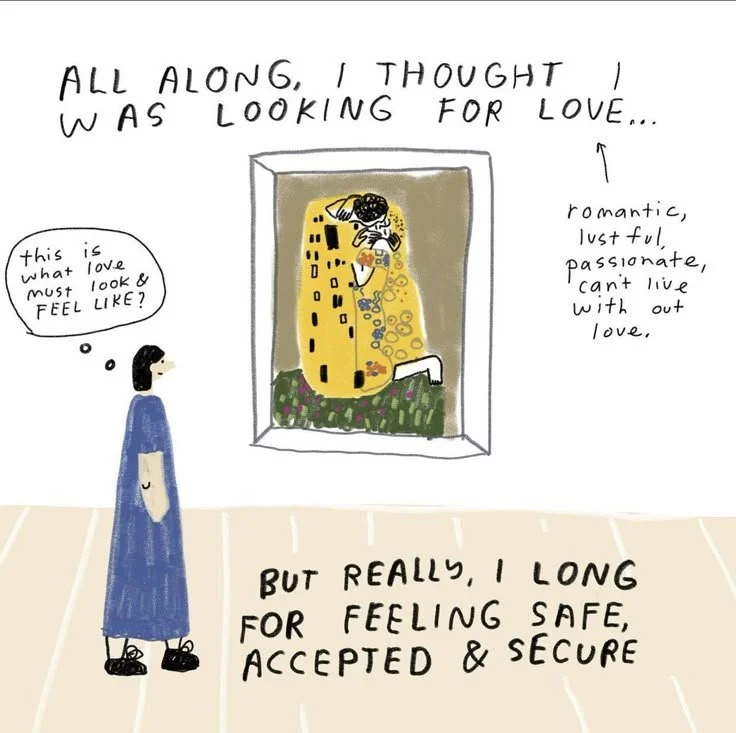
For people who've spent a lot of time adapting to unpredictable, critical or emotionally complicated environments, safety can get especially confusing. Sometimes what feels FAMILIAR isn't actually safe, and what's safe doesn't feel familiar yet. The biggest thing I wish I'd understood earlier is that cultivating a sense of safety has very little to do with convincing yourself nothing bad will ever happen. It's much more about slowly building trust in your ability to notice what's happening, respond to yourself, protect yourself when you need to, and tolerate the uncertainty that comes with being a person in the world.
FEELING SAFE & BEING SAFE AREN’T ALWAYS THE SAME THING
Our sense of safety gets shaped partly by what's happening now and partly by what we've learned before. If conflict used to lead to yelling, rejection, punishment or the silent treatment, even pretty healthy conflict can feel threatening. If disappointing people used to put your relationships at risk, someone's mild "oh, okay" can set off a much bigger internal alarm than the situation calls for. If you spent years monitoring someone's mood, a quiet car ride might send your brain straight to, What did I do?
That doesn't make every uncomfortable reaction trauma. Sometimes your internal alarm is responding very accurately to something happening right now! Other times it's responding partly to what similar situations have meant before. Learning safety is about getting a little better at noticing that difference, without expecting yourself to get it right every single time.
SAFETY ISN’T THE SAME AS NEVER FEELING ANXIOUS
I think this matters because "regulating your nervous system" can very easily turn into one more impossible wellness assignment. If safety means feeling calm, grounded and unbothered at all times, then every anxious moment becomes proof you haven't healed enough yet, and suddenly we're fighting our anxiety SO we can finally feel safe. That's exhausting (and it doesn't work).
You can be safe and anxious at the same time!! You can set a healthy boundary and feel guilty, or make a decision that's right for you and still feel unsure about it for a week. Sometimes cultivating safety looks like learning, I can feel this and still be okay, instead of needing the feeling to disappear before you trust yourself.
SAFETY STARTS WITH ACTUALLY NOTICING WHAT IS & ISN’T SAFE
I don't want to talk about internal safety in a way that encourages anyone to breathe their way through something that's actually harmful. Sometimes anxiety is giving us really important information. Sometimes a relationship really is unpredictable, someone really does keep violating your boundaries, or an environment really is hostile, coercive, abusive or unsafe. No amount of box breathing should be used to talk yourself into tolerating something that calls for protection, support, distance or change.
So part of feeling safer is getting more discerning about what gets access to you. Who consistently respects your boundaries? Who lets you disagree, and where can you make a mistake without being humiliated? Which places require you to monitor yourself constantly? Safety is something we build on the inside, AND our environments and relationships matter too.
PREDICTABILITY CAN HELP CREATE SAFETY
Our brains generally love knowing what to expect. Predictability takes a little uncertainty off our plates, which is one reason routines can feel so grounding. It can be really ordinary: your morning coffee in the same mug, knowing when you'll eat next, a bedtime routine, or telling yourself what's going to happen before you walk into something new.
For someone who grew used to a lot of unpredictability, those little moments of consistency can matter a lot! There's an important catch, though. Safety can't DEPEND on controlling everything, because life is going to stay uncertain and people are going to surprise us. Predictability can support us while we also practice tolerating the moments that aren't predictable at all.
BOUNDARIES CAN HELP TEACH US THAT WE CAN PROTECT OURSELVES
One of the biggest shifts toward feeling safer can come from realizing you're no longer completely dependent on other people behaving exactly how you need them to. You have options now! You can leave a conversation, say no, ask someone not to talk to you that way, change your mind, or limit contact.
This is part of why boundaries matter so much in healing. They're rules for other people, sure, but they also become evidence that you're willing to show up for yourself when something doesn't feel okay. Slowly, "I need everyone around me to behave correctly so I can feel safe" can turn into "I trust myself to notice what's happening and respond."
SAFE RELATIONSHIPS CAN GIVE US NEW INFORMATION
You don't have to learn safety all by yourself, and relationships can be one of the places where our expectations start to change. You disagree with someone and they don't leave. You tell a friend you're hurt and she listens instead of getting defensive, or you say no to brunch and nobody makes it weird.
Those moments can sound almost boring, and that's part of what makes them so powerful. If your past taught you that conflict means disconnection, experiences where conflict and connection coexist give your brain brand-new information. Safe relationships still include misunderstandings, frustration, conflict and repair (I promise nobody gets a relationship where no one ever hurts them). The difference is you aren't required to abandon yourself to stay connected.
YOUR BODY CAN BE PART OF THE CONVERSATION
Sometimes we feel threat in our bodies before we have words for it: our stomach drops, our breathing changes, or we feel numb, shaky or suddenly desperate to leave. Those sensations are useful, but they don't all need to become a mystery we solve perfectly.
Sometimes a racing heart means you're anxious, and sometimes it means you had a third iced coffee :) You might also just be hungry. So instead of deciding what a sensation means right away, we can get curious. What am I noticing? What was happening right before this? Does anything actually need my attention, and what would help me feel a little more supported right now? That might mean slowing your breathing, eating a snack, stepping outside, or calling someone. Being RESPONSIVE to yourself counts for a lot more than being perfectly regulated, and you can also just notice the sensation without rushing to make it go away.
SAFETY CAN ALSO COME FROM LEARNING THAT YOU CAN HANDLE DISCOMFORT
This one changed how I think about safety. At first, safety can sound like creating so much certainty that uncomfortable things never happen. Over time, a deeper kind of safety can come from trusting yourself WHEN uncomfortable things do happen.
I can survive someone being disappointed in me. I can tolerate not knowing exactly what she thinks of me, have an emotion without immediately solving it, make a mistake and repair it, and notice anxiety without obeying it. And if something becomes too much, I can ask for help! That kind of safety comes from the growing belief that you can respond when hard things happen, rather than the promise that they won't.
SMALL EXPERIENCES OF SAFETY COUNT
Cultivating safety doesn't usually look like one huge breakthrough. Most of the time it happens through repetition and really small moments. You spend an evening with a friend you don't have to monitor yourself around. You put your phone in another room for an hour and nothing terrible happens, you tell the truth about which restaurant you actually want, or you rest before the to-do list is finished.
Those moments add up to evidence. I said no, and I survived the guilt. I disagreed, and the relationship was fine. I didn't fix it, and they handled it. I felt anxious, and the feeling eventually changed. One experience won't undo years of learning, but a lot of them really can expand what feels possible!
YOU DON’T HAVE TO FEEL SAFE BEFORE YOU START LIVING
One of the most important things I wish I'd known is that waiting until we feel COMPLETELY safe can keep our lives really small. Sometimes we do need more safety (or a different environment) before moving forward. There are also times when the next step is learning that we can move while some uncertainty is still along for the ride.
We can set the boundary while our hands shake. We can let someone be disappointed while noticing the urge to fix it, or start a healthy relationship while part of us is still waiting for the other shoe to drop. You can be scared and still be the one driving, and fear doesn't get to make every decision for you anymore!
If this resonates with you, especially if anxiety, past relationships or earlier experiences have made it hard to trust that you're safe even when part of you knows you are, this is something we can explore together in therapy. Learn more about how I work with anxiety →
I offer online therapy for women in Alaska, Arizona, Texas, Utah & Washington. Schedule a free 15-minute consultation.
credit: source unknown
