RELIGION, CODEPENDENCY & PEOPLE-PLEASING: WHEN BELONGING REQUIRES SELF-ABANDONMENT
Religion and personal identity can have an incredibly intricate relationship—one might even say, sometimes, an enmeshed one.
Religion can give us community, rituals, values, purpose, family traditions, spirituality, and a framework for understanding ourselves and the world around us. For many people, those things are meaningful, supportive, and freely chosen. Religion itself does not inherently create codependency, people-pleasing, or trauma.
But I think it's worth getting curious about what can happen when belonging within a religious environment becomes strongly connected to obedience, self-sacrifice, approval, conformity, or being a particular kind of “good” person.
Because some of the qualities that may be highly valued in certain religious environments—being selfless, serving others, forgiving quickly, submitting to authority, sacrificing personal desires, avoiding contention, or putting other people's needs first—can look remarkably similar to behaviors we might describe elsewhere as people-pleasing or over-functioning.
The question isn't whether serving, forgiving, sacrificing, or caring for other people is healthy or unhealthy. The question is whether we have a choice.
What happens when being good requires being agreeable? What happens when saying no feels selfish? What happens when disappointing someone feels morally wrong? What happens when trusting yourself feels less virtuous than deferring to someone else's authority?
And what happens when belonging begins to require abandoning parts of ourselves?
BELONGING IS A REALLY POWERFUL THING
Human beings need connection. We want to know that there are people who understand us, care about us, and consider us part of something. Religious communities can meet that need in profound ways by providing shared language, rituals, beliefs, values, traditions, and a sense of purpose.
That connection isn't a problem. In fact, it can be one of the healthiest and most meaningful parts of religion.
But belonging becomes complicated when it feels conditional.
If connection depends on believing the right things, behaving the right way, fulfilling the right roles, or remaining within certain boundaries, we may become very attentive to what keeps us safely inside the group. We notice which parts of ourselves receive approval and which create discomfort. We learn what makes us “good.” We may also learn what could make us disappointing, rebellious, selfish, worldly, unfaithful, or unsafe to belong with.
You don't necessarily need someone explicitly saying, “We will reject you if you change,” for your brain to start paying attention to the conditions surrounding belonging.
Sometimes we learn those conditions through praise, correction, stories, doctrine, family expectations, leadership structures, or simply watching what happens when someone else steps outside of them.
And when belonging matters deeply, adapting ourselves to preserve it can make a lot of sense.
WHEN SELFLESSNESS BECOMES SELF-ABANDONMENT
I want to be careful here because I don't think selflessness is inherently unhealthy. Caring for people matters. Generosity matters. Service can be deeply meaningful. Sometimes we choose to sacrifice something because another person matters to us, and that choice genuinely reflects our values.
But there is a difference between choosing to be selfless and believing that having a self is selfish.
If you've repeatedly learned that goodness means putting yourself last, you may eventually have trouble identifying when you're allowed to consider yourself at all. Having needs might feel demanding. Setting a boundary might feel unkind. Prioritizing yourself might trigger guilt. Saying no to service, a calling, a family expectation, or someone's request might feel like you're failing morally rather than simply recognizing your capacity.
This is where religious values can sometimes become tangled with people-pleasing. You're no longer only asking, “What would be kind?” You may be asking, “What do I have to do to still be a good person?”
Those are very different questions.
WHERE CODEPENDENT PATTERNS CAN ENTER THE PICTURE
I tend to use codependency carefully because it isn't a formal mental health diagnosis, and I don't think it's especially useful to divide people into “codependents” and “non-codependents.” I find it more helpful to talk about codependent patterns: over-functioning for others, feeling responsible for other people's emotions or choices, struggling to identify your own needs, deriving worth from being needed, or having difficulty separating care from responsibility.
Certain religious messages can overlap with those patterns, especially when sacrifice, caretaking, forgiveness, obedience, or responsibility for others becomes central to someone's sense of goodness.
Maybe you learned that your role was to help other people stay on the right path. Maybe someone else's choices felt partly like your responsibility. Maybe you were expected to forgive without enough room for anger, hurt, or boundaries. Maybe service became one of the primary ways you experienced worth. Maybe you became incredibly good at noticing what everyone else needed while becoming increasingly disconnected from yourself.
None of those patterns automatically mean religion caused codependency. Family dynamics, attachment experiences, temperament, culture, relationships, and many other factors can shape the same behaviors.
But religion can sometimes give those behaviors moral meaning.
Instead of simply thinking, “I should take care of everyone,” the belief may become, “Taking care of everyone makes me good.” Instead of “I'm afraid to disappoint people,” it may become, “Disappointing people means I'm selfish.” Instead of “I struggle to set boundaries,” it may become, “A loving person should always be willing to give more.”
And that can make these patterns particularly difficult to question.
WHEN PEOPLE-PLEASING FEELS LIKE BEING A GOOD PERSON
People-pleasing often gets reduced to wanting everyone to like us. Sometimes that's part of it, but it can run much deeper. People-pleasing can be an attempt to maintain safety and connection. We become attentive to what other people need, how they're feeling, whether they're disappointed, and what version of us will make the relationship feel most secure.
In religious environments, there may be additional layers. Maybe you're not only trying to please your parents or community; you're also trying to please God. Maybe someone's disappointment in you feels connected to a larger fear that you're doing something morally wrong. Maybe religious leaders are treated as having particular spiritual authority, which makes disagreeing with them feel different from disagreeing with an ordinary person.
This can make it difficult to know where your values end and fear begins.
Am I doing this because I genuinely believe it's right, or because I'm afraid of what happens if I don't? Am I serving because I want to, or because saying no makes me feel guilty? Am I forgiving because I'm ready, or because anger feels spiritually unacceptable? Am I making this decision because it reflects my values, or because I desperately need everyone around me to believe I'm still good?
Sometimes the answer will be both. That's okay. The point isn't to interrogate every kind thing you've ever done. It's to become curious about how much freedom exists inside your choices.
THE FAWN RESPONSE & RELIGIOUS ENVIRONMENTS
The term fawn response is commonly used to describe appeasing or accommodating behaviors that emerge in response to perceived threat. I think it's useful language for some people's experiences, although I prefer not to treat fight, flight, freeze, and fawn as four rigid categories that perfectly explain everyone's nervous system.
What matters here is the function of appeasement.
If disagreeing, saying no, expressing anger, having different beliefs, or asserting yourself has historically threatened your safety or connection, becoming agreeable can make a lot of sense.
You learn to read the room. You figure out what people want from you. You soften your opinions. You make yourself useful. You become skilled at anticipating what will keep everyone comfortable.
In some religious environments, the perceived threat may include more than interpersonal rejection. There may also be fear of spiritual consequences, divine punishment, losing access to community, disappointing family, jeopardizing an eternal relationship, or becoming the kind of person you've been taught not to become.
That can make compliance feel incredibly high stakes.
And if appeasing authority, staying agreeable, or conforming has repeatedly helped you maintain connection and reduce conflict, those strategies don't necessarily disappear when you leave the religious environment where you learned them.
They can follow you into friendships, romantic relationships, workplaces, and therapy.
AUTHORITY CAN COMPLICATE OUR RELATIONSHIP WITH SELF-TRUST
Religion often involves some form of authority: sacred texts, traditions, doctrine, clergy, leaders, parents, or a community's interpretation of what God expects. Authority itself isn't inherently abusive or unhealthy.
The important question is what happens when your internal experience conflicts with that authority.
Are you allowed to question? Are leaders allowed to be wrong? Can you disagree without being characterized as rebellious, prideful, deceived, or spiritually deficient? Can you make a different decision and remain connected to your community? Can you trust your own perception when someone with more authority interprets your experience differently?
When the answer repeatedly becomes no, we may learn to distrust ourselves.
Instead of asking “What do I think?” we look for someone else to tell us. Instead of “What do I need?” we ask what we should be willing to sacrifice. Instead of “Does this feel okay to me?” we ask whether we're allowed to feel uncomfortable in the first place.
Over time, the challenge may become much bigger than learning to say no. It can involve rebuilding a relationship with our own judgment.
GUILT & SHAME CAN MAKE SEPARATION FEEL DANGEROUS
Guilt can be useful. If I've behaved in a way that violates my values or harms someone, guilt may help me recognize that and repair it. Shame is different: instead of “I did something that doesn't align with who I want to be,” shame can sound more like “There is something wrong with me.”
Religious environments vary enormously in how they approach guilt, shame, forgiveness, morality, and human imperfection. But in environments where shame or fear is repeatedly connected to obedience and belonging, questioning expectations can become emotionally intense.
You may technically know that you're allowed to make your own decision and still feel sick with guilt when you do. You may no longer believe something is sinful and still experience fear when you do it. You may understand intellectually that setting a boundary is healthy and still feel like a terrible person afterward.
Our emotional learning doesn't always update the moment our conscious beliefs do.
Sometimes healing means having repeated experiences of making your own choices, tolerating the guilt or fear that initially follows, and discovering that an uncomfortable feeling doesn't automatically mean you've done something wrong.
PEOPLE-PLEASING CAN CONTINUE AFTER RELIGION
One of the things I find especially interesting is what happens when someone leaves or deconstructs the religious system but keeps the relational rules they learned inside of it.
Maybe you no longer believe you need to sacrifice yourself to be righteous, but you're still the person who always says yes. Maybe you reject the religious role you were given but still feel responsible for everyone's emotions. Maybe you intellectually believe you have autonomy while feeling terrified when someone disapproves of your choices.
This can be confusing because you may think, I don't even believe this anymore. Why am I still doing it?
Because beliefs aren't the only things we learn.
We learn relationships. We learn roles. We learn what connection feels like. We learn what happens when someone is disappointed in us. We learn how to recognize safety and what we're supposed to do when connection feels uncertain.
Leaving a belief system doesn't automatically erase those patterns.
HEALING DOESN’T HAVE TO MEAN BECOMING THE OPPOSITE PERSON
If religion taught you to care for other people, healing doesn't require becoming someone who doesn't care. If service matters to you, you don't have to stop serving. If generosity, forgiveness, community, spirituality, or sacrifice genuinely align with your values, those things can remain part of your life.
The goal isn't to reject every quality that developed within religion simply because religion helped shape it.
Instead, we can start asking whether those qualities have flexibility.
Can I serve and say no? Can I forgive and acknowledge that I was hurt? Can I love someone and disappoint them? Can I care about my community and disagree with it? Can I be generous and have needs? Can I value connection and have boundaries? Can I listen to someone else's wisdom and trust myself?
That flexibility is important because a value feels very different from a requirement.
FIGURING OUT WHAT IS ACTUALLY YOURS
Religious deconstruction sometimes gets described as figuring out what you don't believe anymore. But I think an equally important part is discovering what you genuinely want to keep.
Maybe compassion is still deeply important to you. Maybe service is one of your values. Maybe spirituality still matters. Maybe family, generosity, forgiveness, or community remain central to the person you want to be.
The difference is that now you get to become curious about why.
You get to ask whether you're choosing something because it reflects your values or because you're afraid of what will happen if you don't. You get to notice when kindness becomes self-abandonment, when empathy becomes over-responsibility, when service becomes a requirement for worth, or when belonging starts requiring you to become smaller.
And you get to experiment with something different.
Maybe you say no and let someone be disappointed. Maybe you identify a need without immediately explaining why you're allowed to have it. Maybe you make a decision before polling everyone around you. Maybe you allow yourself to be angry without rushing toward forgiveness. Maybe you let someone misunderstand you without spending hours trying to correct their perception.
Those moments can seem small, but they can be incredibly significant when you've spent years learning that safety comes from being the version of yourself other people need.
Healing from people-pleasing after religion isn't necessarily about caring less. It's about creating enough room inside your relationships for you to exist too.
If this resonates with you—especially if religion shaped your relationship with people-pleasing, self-sacrifice, authority, boundaries, guilt, or your ability to trust yourself—this is something we can explore together in therapy. Learn more about how I work with religious trauma →
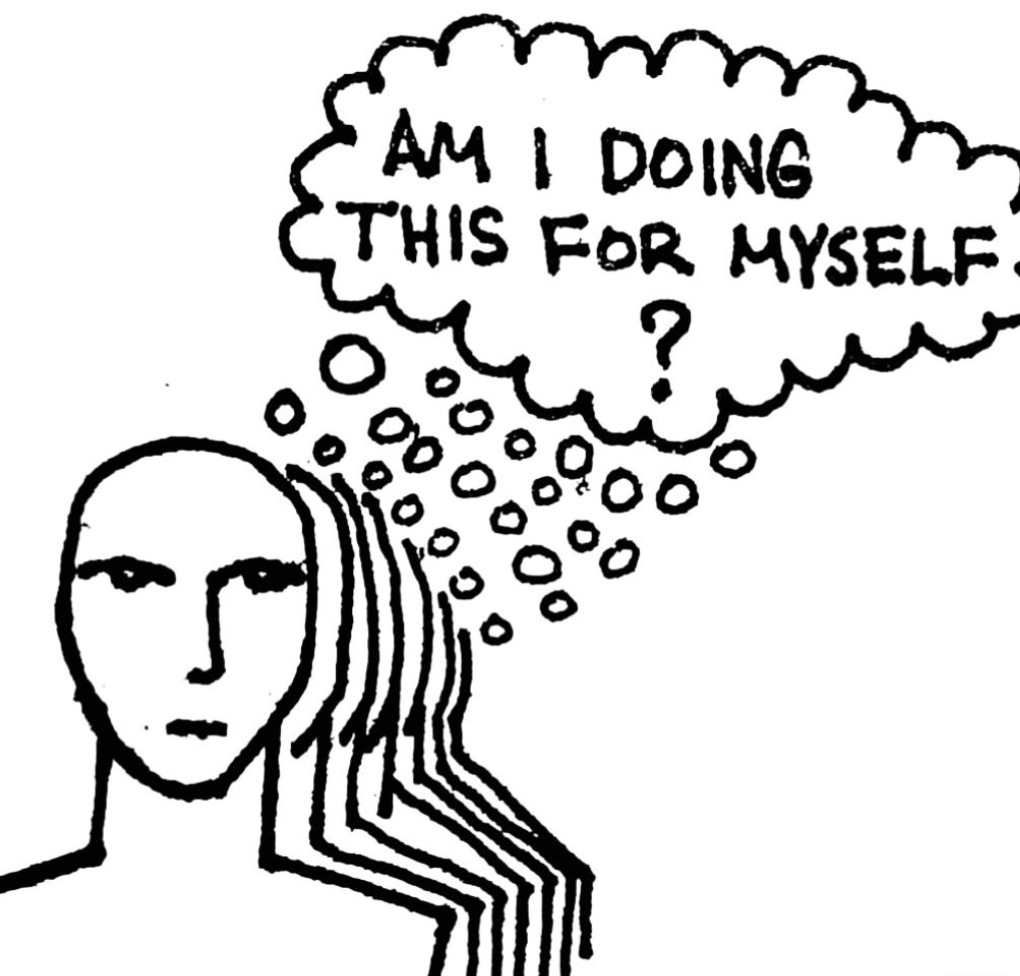
credit: www.instagram.com/verysickinhumancreature
